
5 Signs Your Relationship Needs a Booster Shot
Adult intimate relationships are a lot like our immune system.
A strong immune system is capable of protecting your body and fighting off many viruses and bacteria. It automatically immunizes you against assaults from the outside as well as from the inside—against stress, chronic illnesses, and diseases. When your immune system is functioning well, you barely notice it. It does its job quietly, constantly organizing, managing, and removing toxins. We are learning through emerging medical science how important our gut biome, our sleep, our diet, exercise, and the quality of our lifestyle are to building and maintaining a resilient immune system.
Just like immune systems, a strong, healthy intimate relationship protects each partner, as well as the family unit, from external and internal assaults. Disagreements are handled without becoming gridlocked. We build trust, compassion, and gratitude through everyday actions. We cherish our partner and look for ways to admire, appreciate, and reward them with generosity, forgiveness, and ease.
The Slow Erosion: When a Relationship Weakens
But what happens when your immune system—or your relationship—is weakened through repeated injuries, deprivation, or chronic erosion?
Most of us can relate to what happens in our bodies when we are chronically stressed, sleep-deprived, or neglecting a healthy diet and active lifestyle. We lose energy, restorative sleep declines, we become moody and irritable, and over time, our vital organs begin to decline. We develop more serious illnesses such as diabetes, heart disease, chronic inflammation, arthritis, and a host of diseases that affect our ability to live a full and thriving life.
A very similar process occurs in relationships that receive the same level of neglect. There is a predictable process by which long-term relationships under chronic stress, conflict, outside influences, or internal resentment begin to develop symptoms similar to internal inflammation. Relationships can also be affected by sudden and overwhelming assaults from the outside or inside—an infidelity, the sudden loss of a job, a loved one, or traumatic stress can put a partnership at serious risk.
The Distance and Isolation Cascade
John Gottman, in his five decades of research on happy and ailing relationships, identified a critical process for us to understand: The Distance and Isolation Cascade. This is the slow and predictable slide toward the end of a relationship.
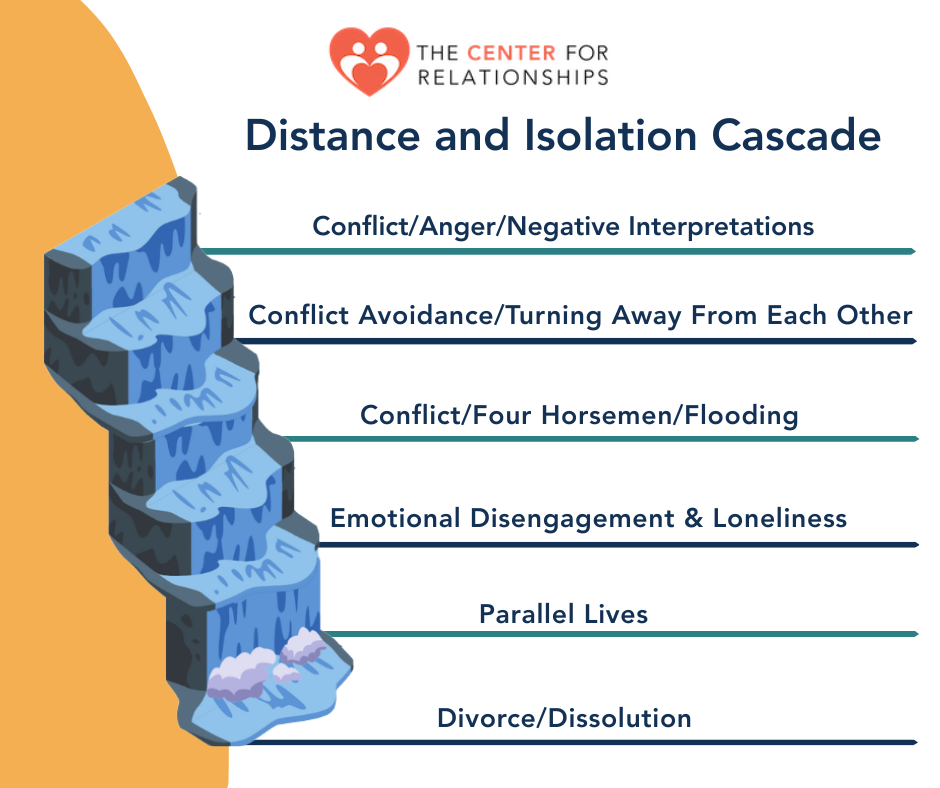
Here are five key signs that your relationship may be caught in this cascade and desperately needs a "booster shot":
1. You Take Each Other for Granted
The courtesy and thoughtfulness that defined the early days of your relationship are gone, replaced by a sense of comfort that has become complacency.
Your partner feels more like a messy sibling, and you are both losing attraction to one another.
You engage in behaviors in front of your partner now that you would never have considered in the first year (e.g., picking your teeth or nose, wearing torn, ratty clothing, or leaving personal waste like fallen hair or q-tips for them to clean up).
You assume basic shared tasks will eventually get done by your partner (e.g., waiting for the dishes to get bad enough, trash piling up, the cat litter becoming the stench of the home, or piles of take out containers and plastic ware).
Shared meals become less generous, like ordering take-out for yourself and leaving the dregs of the feast for the other person.
You don’t consider etiquette or manners important in front of each other anymore. Farts, belches, and other once private habits are on full display.
2. You Actively Turn Away from Each Other
Emotional distance starts to manifest as physical avoidance and a lack of responsiveness. You actively seek disconnection rather than connection.
You create excuses to stay longer at work, the grocery store, or elsewhere because hanging out with your partner is no longer enjoyable.
When your partner makes a request or asks for a favor, you respond with irritation, pretend not to hear them, or simply ignore their request because they don’t deserve even the smallest effort from you anymore.
Evenings are spent in separate corners, engrossed in individual devices, creating physical and emotional barriers within the home.
Your "best" (most peaceful) days are the ones where you barely spoke or saw each other.
Date nights are spent eating in silence in front of the television, a shared presence without true connection.
3. Disagreements Become Passive-Aggressive
The ability to engage in healthy, constructive debate is replaced by subtle hostility, resentment, and quick, draining conflicts.
You stop bothering to argue an issue directly. Instead, you roll your eyes, grunt, make clucking noises, or leave in a huff.
Listening shifts from seeking understanding to finding fault, resulting in nurturing resentment and trashing each other’s personalities during conversations.
Your strategy during arguments includes passive-aggressive muttering, yelling from another room, and door slamming.
What used to be an hour of energizing debate now ends in less than 15 minutes because you both know exactly what button to push to escalate the conflict from 0 to 100.
Fights quickly escalate from frustration to anger to vilification, often ending with threats of divorce or breakup.
4. You Stop Sacrificing for Each Other
Generosity and mutual support erode, replaced by self-interest and an unwillingness to extend grace or effort.
You manufacture excuses to avoid giving your partner a break (e.g., pretending to have too much work to watch the kids so they can spend a night with friends).
You stop forgiving your partner's quirks and mistakes. Instead, you needle, remind, or leave signs of your intolerance (e.g., throwing their favorite item away or "accidentally" breaking a prized possession).
You neglect simple acts of care, such as making soup when they are sick or running out for a late-night pharmacy trip.
You intentionally avoid making small efforts for their comfort (e.g., pretending to be fast asleep to avoid getting up with the kids so your partner can sleep in).
You neglect shared responsibilities, such as letting the car to run out of gas so your partner is forced to deal with it.
5. You Are Living Parallel Lives
The distance is now so severe that your paths barely intersect, and you begin to envision a life without your partner.
The question of compatibility, initially pondered in secret, begins to surface as ultimatums during arguments.
Shared interests disappear (e.g., no longer watching the same TV shows, which eliminates even passive "date nights").
Your family, friends, and even random strangers know more about the ups and downs of your life than your partner does.
You neglect shared spaces, allowing clutter to pile up, or constantly blame each other for not doing more around the house.
You avoid inviting family and friends over because you cannot plan or host a party without showing your deep dislike for one another.
If any of this sounds familiar, don’t be disheartened. It is never too late to turn things around and reverse engineer this cascade toward divorce. It takes mutual effort, commitment, and a willingness to stay curious and build compassion and empathy instead of resentment and anger.
Check out our free download this week to see some of our ideas for how to reverse your distance and isolation cascade.