
Boost Your Happiness Score: 3 Science-Backed Ways to Elevate Your Joy (With or Without Your Partner)
Strong relationships are built by two whole people. When each partner brings genuine well-being into the relationship, the partnership has a sturdier foundation to grow from — and personal happiness isn't a fixed trait. It's a skill you can practice.
This week, we're sharing three research-backed habits that boost individual well-being and, almost as a bonus, strengthen your closest connections. Try them solo, or invite your partner to join you.
1. Tilt Your Day Toward the Positive
Psychologist Dr. Barbara Fredrickson's research on positive emotions shows that flourishing — not just surviving — requires regularly experiencing more positive moments than negative ones. You may have heard the popular "3-to-1 ratio." While the exact number has been debated in the research community, the underlying principle holds firm: positive emotions don't just feel good in the moment. They actively build the inner resources we need to thrive.
Fredrickson calls this the Broaden and Build effect:
Broaden: Positive emotions — joy, curiosity, contentment, gratitude — widen your perspective. You think more flexibly, see more options, and become more open to the people around you.
Build: Over time, those moments accumulate into lasting resources: deeper relationships, stronger resilience, better problem-solving.
Try this today:
End-of-day inventory. Before bed, name one thing that felt hard — a difficult conversation, a stressful deadline, a small frustration. Then deliberately name three positive moments, however small: a warm cup of coffee, a kind text, a moment of laughter with your partner.
Interrupt the rumination loop. When you catch yourself replaying a minor conflict, gently redirect your attention to a pleasant memory or a small kindness you can offer right now.
2. Celebrate Good News — Really Celebrate It
Have you ever shared exciting news with your partner and felt a little deflated by their lukewarm "that's nice"? You're not imagining it.
Research by Dr. Shelly Gable shows that how we respond to each other's good news is one of the strongest predictors of relationship satisfaction — even more so than how we respond during conflict. Gable identified four response styles, and only one actually strengthens the bond:
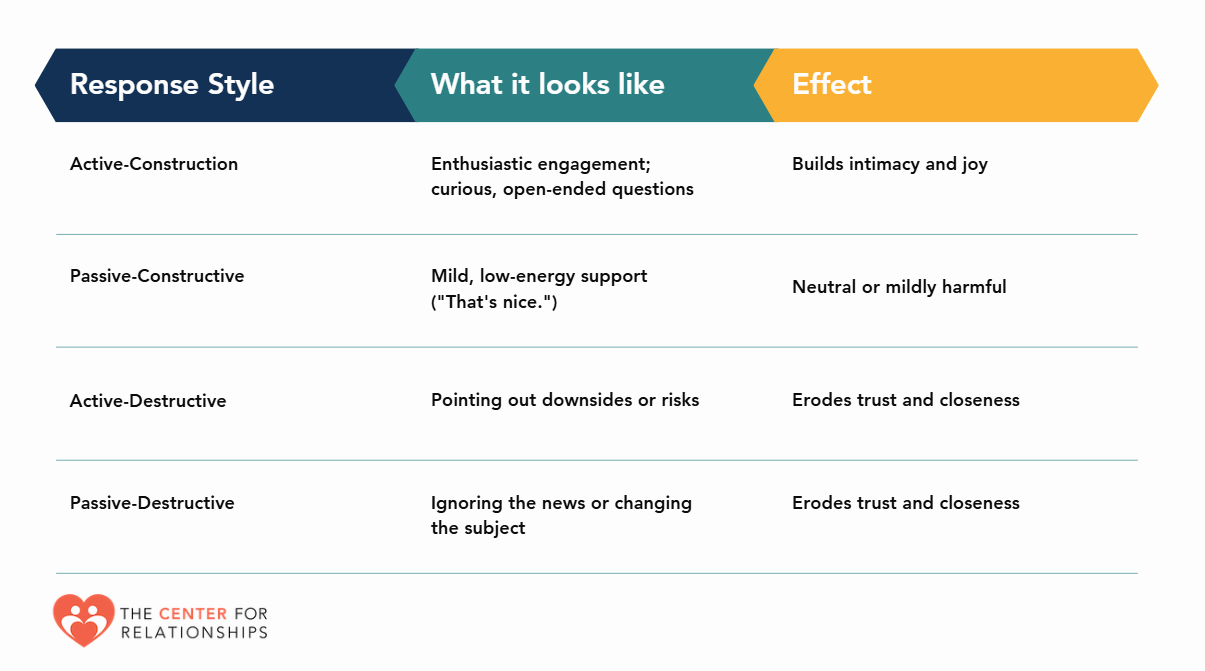
Active-constructive responding is the gold standard — and it's a skill anyone can practice.
Try this today:
When your partner shares good news, put down your phone, make eye contact, and lean in. Ask questions like, "How did you feel when you found out?" or "What are you most excited about?"
Celebrate your own wins, too. When something good happens to you, pause for five minutes. Write down what happened, why it matters, and how it felt. Savoring extends joy and deepens its imprint.
3. Practice Optimism (Without Sugarcoating Reality)
Optimism, as positive psychology pioneer Dr. Martin Seligman defines it, isn't about denying difficulty or pasting a smile over hard things. It's about your explanatory style — the way you instinctively explain why things happen.
Pessimistic explanations tend to be permanent, pervasive, and personal: "I'm bad at this. It always goes this way for me."
Optimistic explanations are temporary, specific, and contextual: "This particular thing didn't go well today, and here's what I can try next time."
Both patterns become habits — and habits can be reshaped.
Try this today: The ABCDE Model
A — Adversity: What actually happened? Stick to the facts.
B — Belief: What did you immediately tell yourself about it?
C — Consequence: How did that belief make you feel and act?
D — Disputation: Challenge the belief. Is it really permanent? Truly pervasive? What's another way to look at this?
E — Energization: Notice the shift — the relief, the clarity, the renewed motivation.
Practiced over time, this small reframe transforms how you meet life's setbacks — and how you show up for the people you love when they meet theirs.
Small Practices, Big Ripples
Here's what we love about these three habits: they're simple, they're free, and they work whether you do them alone or together. Cultivate more positive moments. Celebrate good news fully. Reframe setbacks with both kindness and accuracy.
When you invest in your own well-being, you're not taking anything away from your relationship — you're giving it more to grow on.
Ready to put this into practice? Download our free Joy Builder Challenge — a 7-day guided practice with daily exercises, journaling prompts, and a habit tracker to help you build these habits into your week.