
Protect Your Attention, Preserve Your Connection: Your Best Life Hack for a Stress-Free Life
The Value of Where You Focus
What truly captures your attention dictates the quality of your life.
There is an old adage:
What we give our time to is either our passion or our addiction.
What we spend our energy on becomes our religion.
What receives our attention and interest inevitably becomes what matters most in our lives.
Yet, many of us complain that we are not living a meaningful, fulfilling, or happy life. We feel disconnected from our core values, harbor neglected longings, and nurture resentment for obligations that bring no joy.
Why?
Because we are often giving our most precious resource—our attention—to people, places, and things that do not provide the most valuable and lasting source of happiness.
The Urgency Trap
Stephen Covey famously described the "Urgency Addiction"—the habit of constantly giving our time, attention, and effort to whatever fire is burning directly in front of us. Most of the time, this urgency is defined by someone else's priorities:
Demands from work deadlines and projects.
The constant pull of social media notifications.
The 24/7 cycle of news and world events.
Home and family chores that feel perpetually urgent.
The True Cost of Distraction
Imagine for a moment: If you had only one thought left, what would you miss? What would you regret? What would you be grateful for?
For most of us, that final thought would not be about an unfinished work project, an unmet deadline, or a goal left unachieved. That last thought naturally gravitates toward our most important relationships:
"I love my partner or children so much."
"I wish I had spent more time with my loved ones."
This thought experiment reveals a profound misalignment: we invest our daily attention in the urgent, but our deepest value lies in the connective.
When Depletion Runs the Show
When you say, "I am exhausted and overwhelmed," what are you actually referring to?
This feeling of being depleted is often a combination of maxed-out resources:
Energy stores: Physical exhaustion.
Emotional window of tolerance: Quick to anger or sadness.
Mental capacity: Difficulty focusing or making decisions.
Attention bandwidth: Inability to be present.
Distress tolerance: Low patience for minor stressors.
Relational holding capacity: Inability to be curious or compassionate.
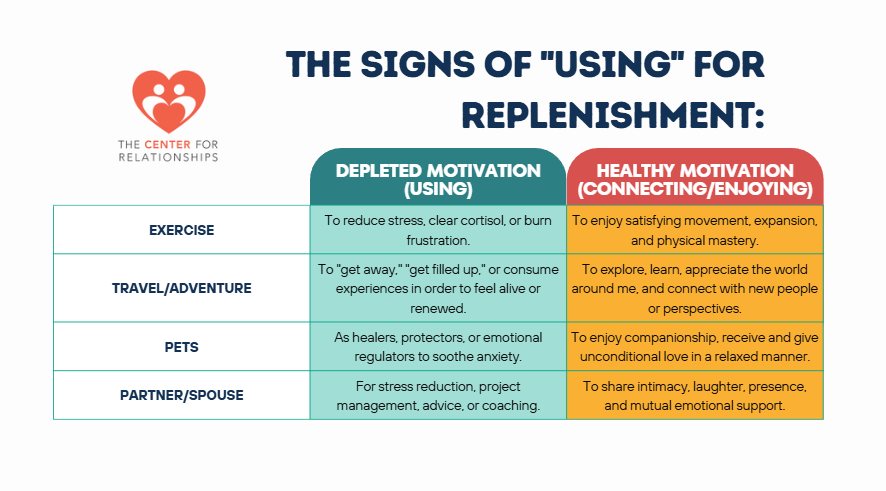
When our attention and energy are depleted, we unconsciously begin to use people, places, and things to replenish ourselves, rather than enjoying them for their inherent value.
The Unseen Burden: How Our Stress Rolls Downhill
When we come to our most intimate moments undernourished, deprived, edgy, and irritated, the resulting disappointment, misunderstanding, and conflict is predictable. We are seeking to get rather than give or be.
Worse, our unmet needs and unfulfilled desires often get passed on to others—the concept that "shit rolls downhill”.
We push our children to be excellent because we are functioning below our own potential.
We demand perfection from colleagues because we depend on their work to soothe our own anxieties about being an imposter.
This is a legacy burden: our own unhealed resentments, grief, and neglected values are projected onto those around us, forcing them to carry the weight of our depletion.
5 Ways to Shift from Depletion to Connection
The goal is to shift from a state of frantic getting to one of relaxed, receptive connection. The greatest connection hack is protecting your attention.
Here are five key actions to preserve your connection by controlling your attention:
Prioritize Relationship Time: Use a planning tool to block out "Non-Negotiable Time" for your partner or family before filling in the urgent demands of work. Think of this as making a deposit into your emotional bank account. (Research supports that prioritizing relationship time is a cornerstone of marital satisfaction, e.g., Gottman Institute findings).
Define Your Own Urgency: Before responding to an external demand, ask: Is this urgent to me or to someone else? If it's not aligned with your core values, be mindful and intentional about how much of your time and energy you give to that task or demand.
Practice Mindful Presence: Set specific "No-Phone Zones" or "No-Work Zones" in your daily routine (e.g., dinner with family, play time, first 30 minutes after getting home). When you are with a loved one, practice A.R.E. skills: Accessible, Responsive, Engaged.
Refuel with Joy, Not Escape: Choose activities for replenishment (exercise, hobbies, time with pets) that are motivated by joyful satisfying movement and expansion, not just stress reduction. True self-care is proactive, not reactive.
Address the Core Needs: When you feel depleted, use "I" statements to own your internal state rather than projecting it onto your partner. Instead of, "You never help me relax," try, "I am feeling overwhelmed right now and need 30 minutes of quiet to reset. Can we connect later?" This protects your connection by separating your stress from your relationship.
By protecting your attention today, you ensure that your moments are filled with genuine presence, and your life reflects what you truly value most.
References
Covey, S. R. (2020). The 7 habits of highly effective people: 30th anniversary edition. Simon and Schuster. (Supports the concept of Urgency Trap and prioritizing non-urgent, important tasks.)
Gottman, J. M., & Silver, N. (2015). The seven principles for making marriage work: A practical guide from the country's foremost relationship expert. Harmony Books. (Supports the A.R.E. skills and the necessity of prioritizing relationship time/deposits into the emotional bank account.)
Hari, J. (2022). Stolen focus: Why you can't pay attention—and how to think deeply again. Crown. (Supports the general theme of attention as a precious resource and the negative impact of external demands.)
Jahn, G., & Wagemann, J. (2018). Emotional labor in romantic relationships: An examination of stress, coping, and partner well-being. Journal of Family Psychology, 32(6), 754–763. (Supports the concept of "using" a partner for emotional regulation and the stress it places on relationships.)
Newport, C. (2016). Deep work: Rules for focused success in a distracted world. Grand Central Publishing. (Supports the economic and personal value of sustained, concentrated attention in modern life.)
Seligman, M. E. P. (2011). Flourish: A visionary new understanding of happiness and well-being. Free Press. (General reference for PERMA model and the importance of relationships in well-being.)
Pew Research Center. (n.d.). Digital media and technology news. Retrieved from [Insert relevant Pew Research URL, e.g., for specific report on social media and mental health]. (General reference for the impact of constant connectivity and social media on mental health and social well-being.)
Helliwell, J. F., Layard, R., Sachs, J. D., De Neve, J.-E., Bédard, I., & Wang, S. (Eds.). (Year of latest report). World Happiness Report. [Publisher/Source URL]. (General reference for the annual reports highlighting social support and relationships as key predictors of well-being.)